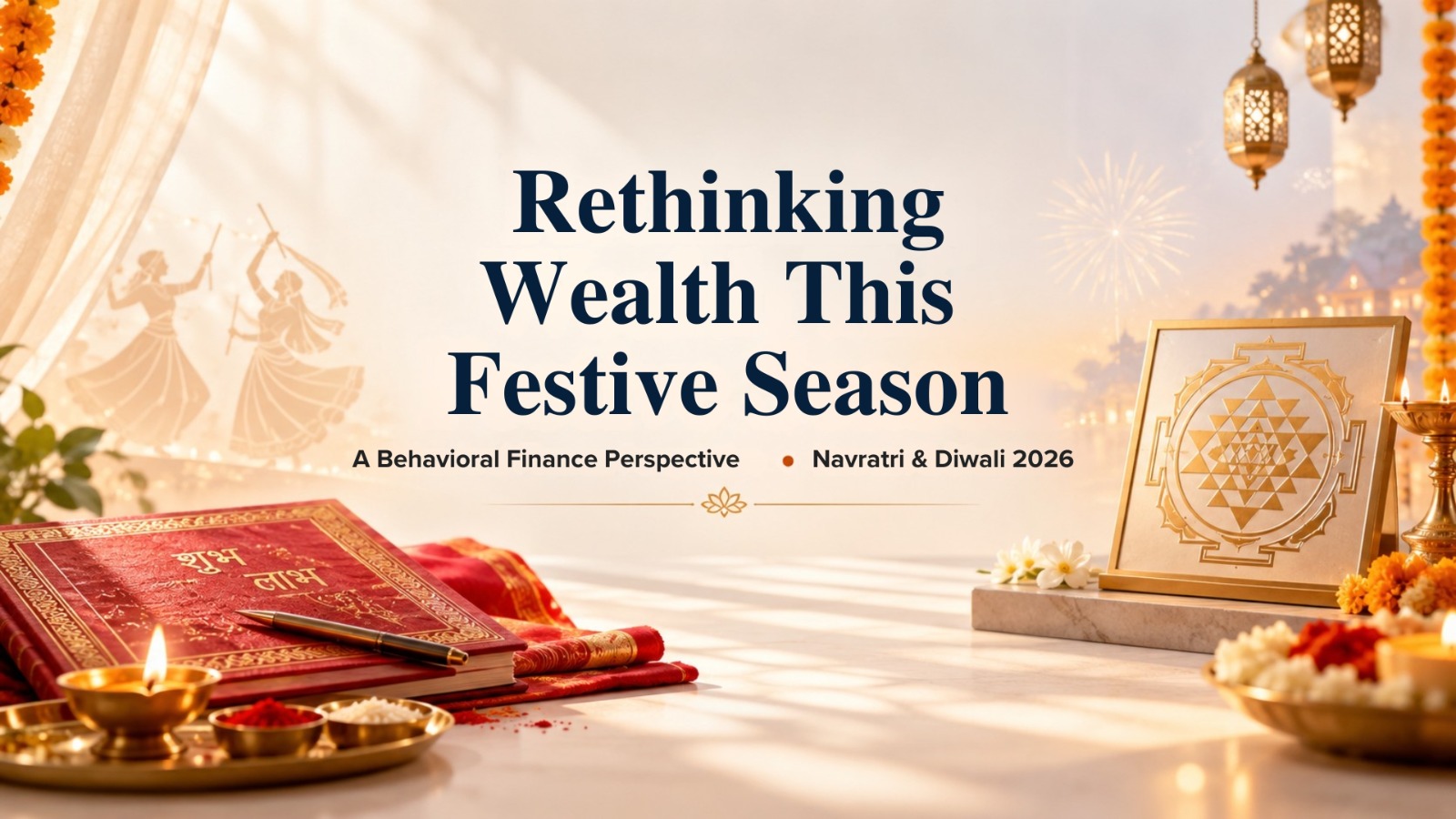
Every year, as the diyas come out and the house gets a fresh coat of paint for Navratri and Diwali, something quieter happens alongside the celebrations. Families sit with questions that have little to do with rangoli patterns or sweet boxes — questions about saving, spending, gold, giving, and what money is actually for. If there is one month in the Indian calendar built for healing your relationship with money, it is this one. And this year’s festive numbers make that healing feel timely.
Festive trade is expected to cross ₹1 lakh crore around Dhanteras alone, with gold and silver purchases making up a large share of it — even with gold prices sitting at record highs near ₹1,34,800 per 10 grams [1,2]. By pure logic, record prices should slow buyers down. They haven’t. People are choosing coins over heavy jewellery, silver over gold, but the instinct to buy something this week — to invite a little prosperity into the home — hasn’t faded one bit [2,3].
At the very same time, a gentler statistic quietly tells a parallel story: Indian households give away an estimated ₹54,000 crore every year, in cash, in kind, and in time. Sixty-eight percent of people report giving something. And for more than nine in ten of them, the reason isn’t a tax deduction or a strategic decision — it’s simply a sense of duty [4].
Put these two numbers side by side, and a pattern emerges. Neither the gold nor the giving is being treated the way a finance textbook would expect. Nobody buys Dhanteras gold like they buy a stock. Nobody gives like they’re filing an expense. Both feel more like something being honoured than something being acquired.
Two Very Different Ways to Hold Money
There’s a simple but powerful idea in psychology called psychological ownership — the feeling of ‘this is mine’ that we attach to things, whether or not we actually have legal claim over them. What’s interesting is that this feeling isn’t fixed. The very same rupee can be held with two completely different mindsets.
One is the owner mindset: money exists to serve me — my comfort, my status, my choices. The other is the trustee mindset: money is simply passing through my hands on its way to something or someone — a child’s future, a parent’s care, a promise kept.
The difference matters more than it sounds. An owner mindset makes every market dip, every big expense, every comparison with a neighbour’s new car feel personal — almost like an attack on who you are. A trustee mindset softens all of that, because the money was never only about you to begin with. It had a job to do, and that job hasn’t changed just because its price did.
Seen this way, Navratri and Diwali already teach this lesson every single year. Dhanteras gold is rarely bought as a trade — it’s bought to be kept, worn, inherited, and eventually handed down. And that ₹54,000 crore in everyday giving isn’t framed by most people as ‘spending.’ It’s framed as dharma — an old, familiar word for something you simply owe the world around you [4,5].
Why This Balance Gets Lost
Modern money advice, for all its usefulness, nudges us hard toward the owner mindset — bigger portfolios, personal milestones, individual retirement numbers. None of that is wrong. But a plan built only around ‘what’s mine’ tends to come with a quiet cost: a kind of anxiety that rises and falls with every market headline, because the money has nothing to stand on except its own number.
A Few Ways to Bring the Balance Back
- Give every goal a face, not just a figure. Instead of saving toward ‘₹50 lakh,’ save toward your daughter’s college, or your parents’ comfort. A number with a purpose feels completely different to carry.
- Make giving part of the plan, not an afterthought. Most Indian households already do this instinctively — formalising it, even in a small way, keeps that trustee feeling alive all year, not just during festive season.
- Check your wealth against its purpose, not just the market. Once a year, ask ‘is this still doing what I built it for?’ instead of only ‘is it up or down?’
- Pass on the story, not just the asset. Festive gold is often bought precisely to be inherited one day. The gifts that mean the most usually come with a why, not just a how much.
This festive season, as lamps are lit and gold quietly changes hands across the country, there’s a gentle reminder worth holding onto: the healthiest relationship with money isn’t about owning more of it. It’s about remembering, warmly, who — and what — it was always meant for.
References
[1] News Arena India. “Spending on Dhanteras hits record ₹1 lakh-cr on gold, silver rush.” 2026. newsarenaindia.com
[2] Outlook Business / PTI. “Dhanteras Gold Buying Kicks Off, Record Prices May Dampen Volumes By 15pc.” 2026. outlookbusiness.com
[3] Business Standard. “Why Dhanteras remains India’s biggest gold-buying day despite record prices.” business-standard.com
[4] Centre for Social Impact & Philanthropy, Ashoka University. “How India Gives 2025–26.” February 2026. indiacsr.in
[5] Dasra & Bain & Company. “India Philanthropy Report 2026: The step change India needs.” February 2026. bain.com