
MeghnaDangi

The Case for Doing Nothing: When Status Quo Bias Works in Your Favour

We like to believe we make choices all day. In practice we make far fewer. We keep the same bank, the same route to work, the same phone plan and the same portfolio, because changing feels like effort and risk while staying feels like nothing. Behavioral finance calls this status quo bias. It is usually

The Case for Doing Nothing: When Status Quo Bias Works in Your Favour Read More »

The Compounding Mindset – Why Consistency Beats the Highest Return

This is my 50th blog, and I want to use it to say what I have been trying to do across all fifty. Most financial content tells you what to buy. This series asks a different question: why do intelligent, well-informed people keep making the same money mistakes? Every post sits within behavioral finance, the

The Compounding Mindset – Why Consistency Beats the Highest Return Read More »

FII Selling and Your Wealth: Why Checking Less Pays More

Since January, Indian investors have woken up to the same headline in different wording: foreign money is leaving. The numbers are real. Foreign portfolio investors (FPIs) sold Indian equities in every month of 2026 except February, and March alone saw ₹1.18 lakh crore go out [1]. In the first half they sold roughly ₹2.74 lakh

FII Selling and Your Wealth: Why Checking Less Pays More Read More »

Rethinking Wealth This Festive Season: A Behavioral Finance Perspective Navratri & Diwali 2026

Every year, as the diyas come out and the house gets a fresh coat of paint for Navratri and Diwali, something quieter happens alongside the celebrations. Families sit with questions that have little to do with rangoli patterns or sweet boxes — questions about saving, spending, gold, giving, and what money is actually for. If

Rethinking Wealth This Festive Season: A Behavioral Finance Perspective Navratri & Diwali 2026 Read More »

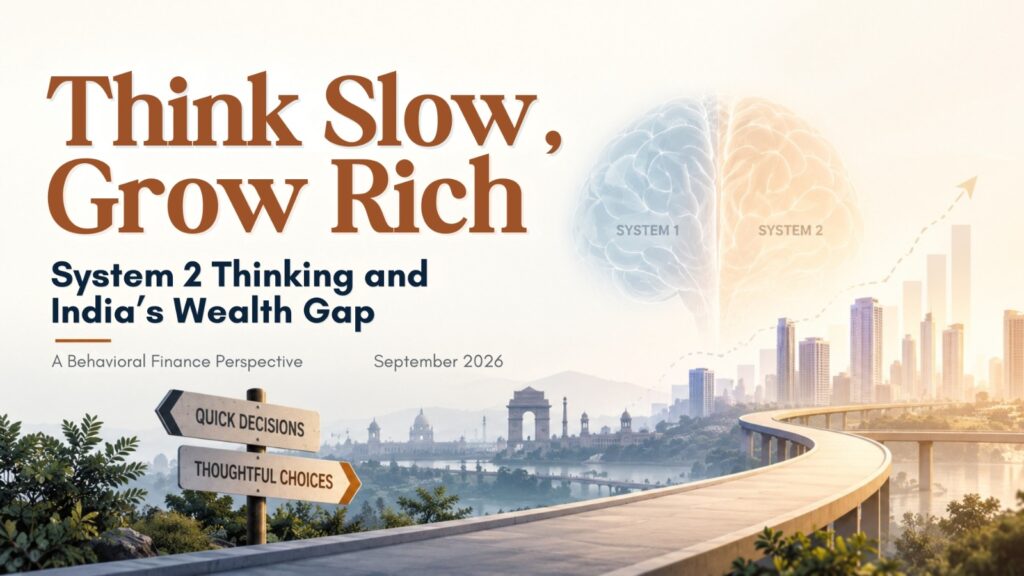
Think Slow, Grow Rich: System 2 Thinking and India’s Wealth Gap

There is a quiet contradiction sitting inside India’s personal finance data right now, and it says more about psychology than about economics. A recent industry survey found that 75.5% of Indians nearing retirement have no detailed financial plan for it — yet 61.4% of that same under-prepared group believe they will retire comfortably anyway [1].

Think Slow, Grow Rich: System 2 Thinking and India’s Wealth Gap Read More »

Why Losses Hurt Twice as Much: Prospect Theory and India’s 2026 Retail Sell-Off

There is a peculiar arithmetic at work in the Indian investor’s mind right now, and it has nothing to do with P/E ratios or earnings growth. It has to do with pain — specifically, the disproportionate pain of watching money disappear. The data tells the story starkly. India’s benchmark Sensex is down roughly 3.78% over

Why Losses Hurt Twice as Much: Prospect Theory and India’s 2026 Retail Sell-Off Read More »

Chalk, Class, and Compounding: A Financial Planning Lesson for Teachers this Teachers’ Day

Every September, India pauses to honour the people who quietly build its future one classroom at a time. But beyond the garlands and the greeting cards, it’s worth looking at just how large — and how varied — this workforce really is, and at the financial blind spots that run across almost all of it,

Chalk, Class, and Compounding: A Financial Planning Lesson for Teachers this Teachers’ Day Read More »

Small, Scheduled, Simple: The Case for Mutual Funds as Gen Z’s Default Vehicle

Every generation eventually asks the same practical question: intent is not enough, so through which instrument does one actually act on it? For a generation raised on small, frequent, low-friction transactions – a coffee subscription here, a split bill there – the answer turns out to be closer at hand than it first appears. Mutual

Small, Scheduled, Simple: The Case for Mutual Funds as Gen Z’s Default Vehicle Read More »

From Financial Anxiety to Financial Independence: Building a Gen Z Wealth Strategy

In Part 1 of this series, we explored why Gen Z’s relationship with money is both fascinating and contradictory. This is a generation that is financially curious, digitally connected and increasingly willing to participate in markets, yet is also vulnerable to impatience, social comparison, overconfidence and the attraction of immediate gratification. But understanding behavior is

From Financial Anxiety to Financial Independence: Building a Gen Z Wealth Strategy Read More »

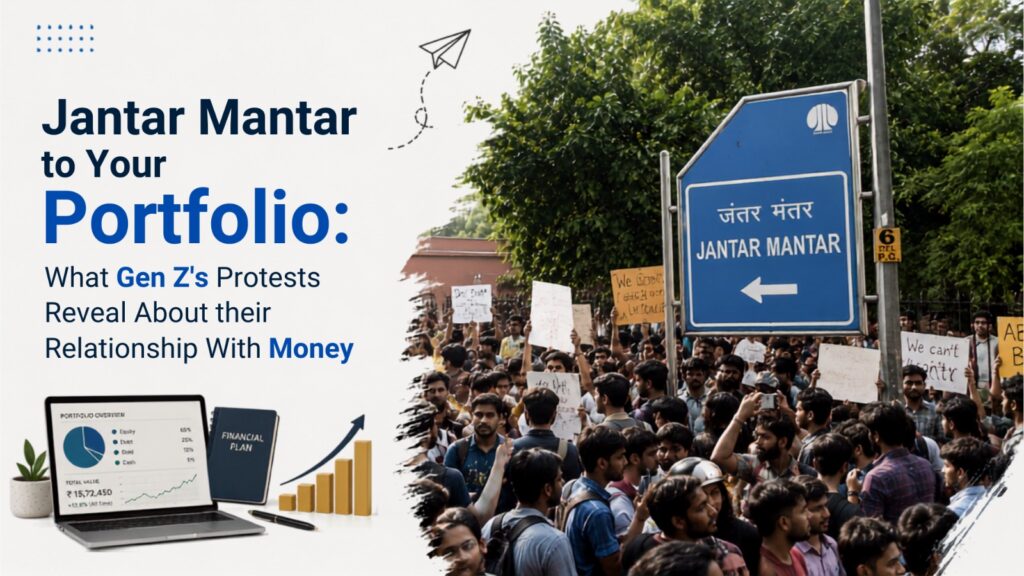
Jantar Mantar to Your Portfolio: What Gen Z’s Protests Reveal About their Relationship With Money

On July 20, 2026, thousands of young Indians tried to march from Jantar Mantar to Parliament. They were met with tear gas, baton charges, and prohibitory orders. The protest, led by the satirical-turned-serious Cockroach Janta Party, was ostensibly about alleged irregularities in the NEET examination and the resignation of the Union Education Minister. But scratch

Jantar Mantar to Your Portfolio: What Gen Z’s Protests Reveal About their Relationship With Money Read More »