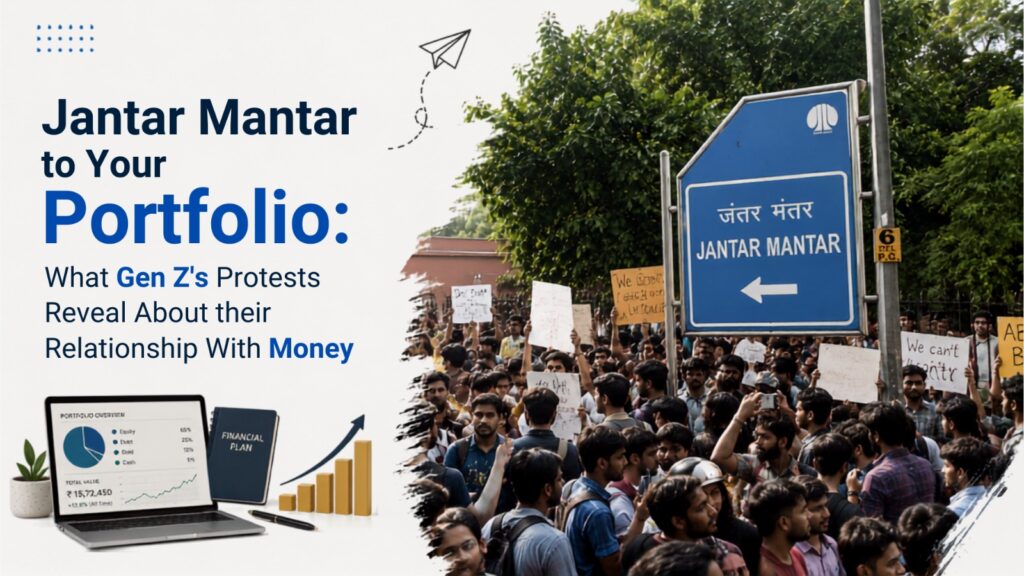
On July 20, 2026, thousands of young Indians tried to march from Jantar Mantar to Parliament. They were met with tear gas, baton charges, and prohibitory orders. The protest, led by the satirical-turned-serious Cockroach Janta Party, was ostensibly about alleged irregularities in the NEET examination and the resignation of the Union Education Minister. But scratch the surface, and the grievance runs deeper. As commentators tracking the unrest have noted, the anger is rooted in youth unemployment and a shrinking sense of economic mobility, in a country where nearly a quarter of the population is under 25 and increasingly aware – via smartphone, in real time – of how far the system’s promises have drifted from its delivery.
I raise this not as a political commentator, but as a behavioural finance academician, because I believe the protest and the portfolio are more connected than they appear. A generation that has watched an exam system fail it, watched its parents’ job security erode overnight during the pandemic, and now enters adulthood questioning whether the old ladder to security still works, is a generation forming its money habits under conditions of high mistrust and high anxiety. That emotional starting point matters enormously for how Gen Z saves, spends, and invests – and for the biases a financial planner must anticipate rather than merely correct after the fact.
The paradox of participation
Gen Z is, by the numbers, the most financially “present” generation India has produced. Industry data shows Gen Z’s share of NSE-registered investors rose from roughly a quarter in FY20 to nearly 40 per cent by FY25-26, while the median investor age has fallen from 38 to 33. Nearly six in ten new stock-market investors added since FY20 have been under 30. This looks, at first glance, like precocious financial maturity. Yet participation is not the same as prudence.
I say this with some conviction because my classroom has told me the same story long before the data caught up with it. Whenever I have interacted with youngsters on money matters and financial planning, I have found them remarkably interested and unusually conscious for their age – far more curious about why they behave with money the way they do than about which stock to buy next. Some years ago, when I introduced a choice-based credit course on Personal Finance and Money Management as a professor, I expected it to draw commerce and management students almost by default. Instead, it consistently found enthusiastic takers from the School of Liberal Arts and Human Studies, the School of Design, and the School of Hospitality – students with no formal finance background at all, but with a very real anxiety about their financial future and a genuine appetite to understand it. That pattern has stayed with me: this generation is not financially indifferent. If anything, it is financially eager, even when it is behaviourally undisciplined.
That combination – high interest, high anxiety, and biases it has rarely been taught to recognise – is what makes Gen Z’s money behaviour worth examining closely, and it shows up in patterns that behavioural finance has long since named.
Herding and overconfidence
These twin biases lead individuals to mistake the visibility of a crowd, or a handful of viral success stories, for genuine competence – a pattern that shows up starkly in India’s equity derivatives segment, where SEBI’s own study found that roughly 91 per cent of individual traders lost money in FY24-25, with aggregate losses crossing Rs.1 lakh crore, and where the share of young traders in this pool has been rising.
Present bias, dressed as ambition
Behavioural economists have long documented hyperbolic discounting – the tendency to overweight immediate rewards relative to distant ones. For a generation raised on instant delivery and instant content, a SIP that compounds quietly over fifteen years competes poorly, emotionally, with anything that promises resolution by Friday. It does not help that trust in slow, institutional pathways – the very exam systems and job markets Gen Z is protesting against – has been visibly shaken.
Social comparison in a scrollable world
Where earlier generations compared themselves to neighbours, Gen Z compares itself to a curated, global feed. This amplifies both lifestyle inflation and financial anxiety simultaneously, a dynamic increasingly documented in research on social media’s effect on youth financial well-being and materialistic spending patterns.
Mental accounting under distrust.
When formal systems feel rigged – an exam paper leaked, a job market that does not reward credentials as promised – young savers often retreat into fragmented mental accounts: an emergency stash on one app, speculative money on another, “fun money” set aside for lifestyle purchases, with little coherence between them. Ironically, this is also the generation most drawn to disciplined SIPs, with under-35 investors accounting for roughly 40 per cent of new SIP registrations in 2025 – evidence that the instinct toward discipline exists, but coexists uneasily with the instinct toward impulse.
The generation marching against a system it believes has failed it is, in my experience, also the generation most willing to sit in a classroom – or scroll through a feed – and ask honestly why it makes the money choices it does. That willingness is the real starting point. Naming these biases, however, is only half the work. The more useful question – how does one actually build a financial plan around a mind wired this way, rather than in spite of it – deserves its own space. That is the conversation I will take up next.
References
- CNN, “India’s CJP protests: Why Gen-Z’s political fury is boiling over in Delhi,” July 2026.
- CNBC, “Gen Z protests led by India’s ‘Cockroach party’ are testing Modi’s leadership,” July 2026.
- IBEF, “The New Indian Investor: Young, Digital & Confident,” citing NSE and RBI data, February 2026.
- The Financial World, “Gen Z Emerges as a New Force in India’s Economy,” citing SEBI Investor Survey 2025 and NSE data, July 2026.
- SEBI / Business Standard, “Net losses of individual traders in F&O widened in FY25: Sebi study,” July 2025.
- Business Standard, “Sebi study exposes massive losses for individual F&O traders in India,” citing SEBI’s FY22- FY24 derivatives study, 2024-25.
(Part 1 of a two-part series. Part 2 will address practical financial planning solutions for Gen Z.)