A few weeks ago, a client in his early fifties sat across from me with a look I have seen many times. His daughter was getting married. The venue was booked, the caterer confirmed, the jeweller paid. His mutual fund portfolio — carefully built over fifteen years — sat at a healthy ₹45 lakhs. And yet, he was asking me whether he should redeem part of it to pay for the wedding expenses. I asked him a simple question: “What if you didn’t have to?”
He looked puzzled. To him, the equation was straightforward — you need money, you use your savings. The idea that he could borrow against his own portfolio, retain every unit of it, let it keep compounding, and repay the loan over twelve months at roughly 10% per annum — all while his investments continued to earn 12–14% — had simply never crossed his mind. This is not a unique story. It is, in fact, a generational one. Our attitude towards loans is not purely financial. It is psychological, cultural, and deeply generational. Understanding how different generations think about debt is the first step toward using it intelligently.
Baby Boomers & Gen X: “Na Lo”
For Indians born between roughly 1946 and 1980, debt carried the weight of moral failure. Growing up in post-Independence India — an era of scarcity, savings-first culture, and the joint family system as a financial safety net — borrowing money was something you did only when you had absolutely no other choice. The neighborhood bank manager was a figure of authority, loans required collateral, guarantors, and considerable paperwork, and the social stigma of being “in debt” was real and lasting. This generation’s financial philosophy was built on one cardinal rule: spend only what you have. The aspiration was always to own things debt-free — the home, the car, the child’s education, even the marriage. EMI was, for many in this cohort, a four-letter word. The behavioral underpinning here is what psychologists call loss aversion — the deep discomfort of owing something, which feels far worse than the potential gain of deploying borrowed capital productively. Combined with a cultural narrative that equated financial virtue with frugality, an entire generation internalized the belief that all loans are inherently bad.
Millennials: “Zaroorat Ho To Le Lo”
India’s Millennials — born between 1981 and 1996 — grew up watching the economy liberalize. They entered the workforce in the era of home loans at reducing interest rates, education loans for MBAs abroad, and car finance that became mainstream. For this generation, borrowing shifted from a last resort to a considered tool: acceptable, but only when necessary.
Recent data confirms this behavioral profile. Between January and September 2025, Millennials accounted for 55.2% of new borrowing in India, holding 269 out of 507 credit card accounts, 238 out of 462 vehicle loan accounts, and 191 out of 425 home loan accounts tracked. For Millennials, EMIs have become a normal financial tool — but the dominant use case is still asset creation: a home, a degree, a car. Lifestyle borrowing remains tinged with guilt. The Millennial attitude is nuanced: loans are not shameful, but they are not smart either. They are transactional — a bridge to something specific, to be repaid and forgotten as quickly as possible.
Gen Z: “Mil Raha Hai To Le Lo”
And then there is Gen Z — born after 1997, the first truly digital-native generation of Indian borrowers. This cohort arrived into adulthood already holding a credit card, already on a Buy Now Pay Later platform, already comfortable with the idea that money can be borrowed in three clicks and repaid in ten installments. According to Paisabazaar, the top reason for personal loans among youth in the first half of 2025 was travel — a trend driven overwhelmingly by Gen Z and millennials. Other major reasons include consumer electronics, medical emergencies, daily expenses, and home renovation. For Gen Z, borrowing is not even a conscious decision — it is a feature of the digital financial ecosystem they inhabit. A report by Redseer Strategy Consultants projects that digital lending will comprise 5% of all retail loans by FY28, driven primarily by Gen Z (aged 18–25) and millennials (aged 26–38), who are rapidly reshaping how borrowing works in India. The risk, of course, is that easy access to credit without financial literacy is a combustible combination. Only 27% of Indian adults are financially literate — far below the 52% average across advanced economies — which directly increases vulnerability to predatory lending, BNPL products, and high-cost fintech borrowing.
So, Is Taking a Loan a Bad Thing?
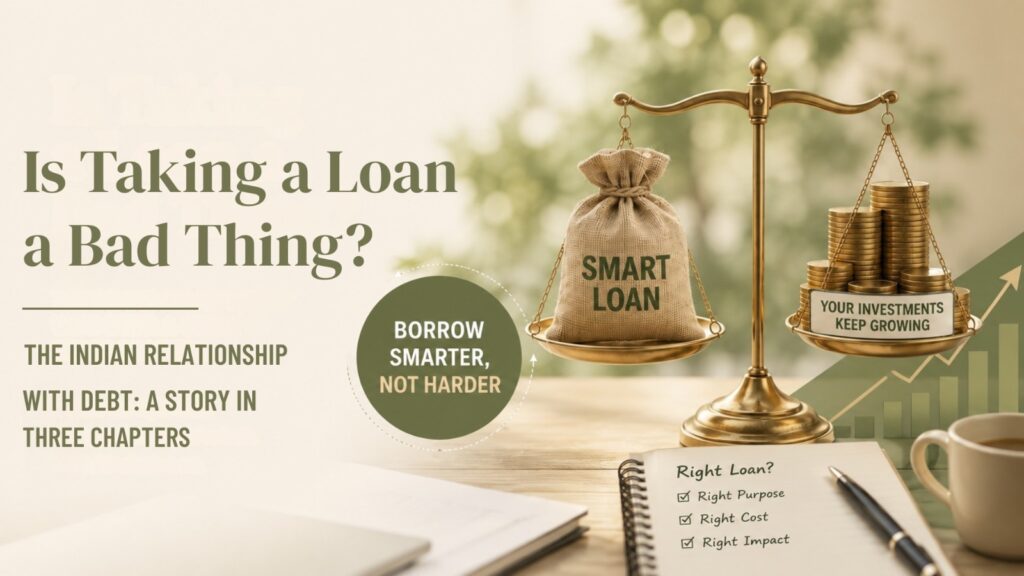
The honest answer is: it depends entirely on which loan, for what purpose, and at what cost.
A personal loan at 18–24% to buy a smartphone you cannot afford is financial self-harm. A home loan at 8.5% to build an asset that will appreciate over twenty years is rational leverage. And a Loan Against Securities at 9–11% to meet a short-term cash need — while your portfolio keeps compounding — is, in many cases, the smartest financial decision you are not making.
The problem is not loans. The problem is undiscriminating attitudes toward loans — whether the Baby Boomer refusal to use any credit at all, or the Gen Z tendency to treat credit as income.
The Smartest Loan You Have Probably Never Used
Let me introduce — or reintroduce — Loan Against Securities (LAS). A Loan Against Securities is a secured loan where you pledge financial assets — shares, mutual funds, bonds, insurance policies — as collateral to get cash. You retain ownership of your assets while using them to back the loan. The lender typically advances up to 50–80% of your portfolio value, and you pay interest only on the amount you actually withdraw.
As of 2026, top banks and NBFCs offer LAS rates starting at roughly 6.75–9% for prime borrowers, with typical customers seeing rates in the 10–15% band. Compare this with personal loan rates that can range anywhere from 12% to 36% — and the structural advantage of LAS becomes immediately apparent. But the rate is almost a secondary benefit. The primary one is this: your investments stay invested.
Why Not Liquidating Your Portfolio Changes Everything
Consider two scenarios.
Scenario A: You need ₹5 lakhs for a home renovation. You redeem your equity mutual fund units. The fund has compounded at 13% annually over eight years. You receive the ₹5 lakhs. Your portfolio shrinks by that amount. The power of compounding on those units — which would have multiplied significantly over the next decade — is permanently disrupted.
Scenario B: You take a Loan Against Securities of ₹5 lakhs against the same mutual fund units at 10.5% per annum. You repay over twelve months in simple EMIs. Your total interest cost is approximately ₹28,000–₹30,000. Meanwhile, your mutual fund continues to compound. The units you “would have” redeemed continue to grow.
In most market conditions where your portfolio returns exceed your LAS interest rate — and India’s long-term equity CAGR of 12–14% generally makes this a reasonable assumption over medium horizons — you come out ahead by borrowing rather than redeeming. This is not sophistry. This is the fundamental logic of leverage used by every sophisticated wealth manager in the world. Opting for an NBFC LAS also means your pledged securities continue earning dividends, interest, or capital appreciation. Retaining ownership while accessing liquidity is the core proposition.
Real-Life Scenarios Where LAS Makes Sense
Travel and experiences: Travel is now the top reason for personal loans among young Indians. If you are going to borrow for a Europe trip regardless, doing so at 10% against your mutual fund portfolio rather than at 22% via a personal loan saves you thousands in interest — and keeps your long-term wealth intact.
Gadgets and lifestyle upgrades: A new laptop for ₹1.5 lakhs on a personal loan at 18% costs you ₹14,000–₹15,000 in interest over a year. The same need met via LAS at 10% costs you ₹8,000–₹9,000. Same purchase, same lifestyle — but your portfolio has not been touched.
Home renovation: Large, lumpy expenses like kitchen renovations or bathroom overhauls routinely cost ₹5–20 lakhs. LAS allows you to fund these without dismantling the SIPs you have been building for years.
Emergency liquidity: NBFCs typically offer shorter processing times and minimal paperwork for LAS, enabling same-day loan disbursal in many cases. In a medical or family emergency, this speed is invaluable — and far preferable to the forced sale of investments at a market low.
Business or opportunity bridge: A short-term business opportunity, a down payment that needs to be arranged in forty-eight hours, a sudden tax payment — LAS functions as an overdraft facility against assets you already own.
The Safeguards Worth Understanding
LAS is not without structure and risk. A financially literate borrower must understand three things.
First, margin calls. If your pledged securities fall sharply in value and breach the lender’s Loan-to-Value (LTV) threshold, you will be required to either pledge additional securities or partially repay the loan. This is the discipline the product demands, and it is why LAS is not suitable for investors who are fully leveraged or who hold concentrated, volatile positions.
Second, the cost-return equation must always hold. LAS makes sense when your expected portfolio return meaningfully exceeds your borrowing cost. In a severe bear market where both your portfolio is falling and you are paying interest, the arithmetic deteriorates. Use LAS for short-to-medium term liquidity needs, not as a permanent lever.
Third, choose regulated lenders. Leading banks and NBFCs offering LAS are regulated by the RBI. Avoid unregulated platforms offering credit against securities with opaque terms.
A Framework for Every Generation
For Baby Boomers and Gen X: Your aversion to debt has served you well. But there is a middle path between reckless borrowing and never using credit at all. LAS, used selectively for genuine short-term needs, does not compromise your financial values — it enhances them. You keep your wealth intact and your dignity intact simultaneously.
For Millennials: You are already comfortable with structured borrowing. The upgrade is simply to borrow smarter. Before reaching for a personal loan or redeeming a mutual fund, ask whether LAS can serve the same purpose at a lower cost and without portfolio disruption.
For Gen Z: The ease of credit is not the same as the wisdom of credit. Before the next BNPL purchase or instant fintech loan, ask yourself three questions: What is the actual interest rate? Does this purchase build value or just consume it? And is there a smarter way to fund this need?
The Final Word
Debt, like fire, is neither good nor bad in itself. It is a tool. Used with intention and understanding, it amplifies your ability to live well and build wealth simultaneously. Used carelessly, it erodes the very foundation you are trying to build.
The goal of intelligent personal financial planning is not to avoid all debt. It is to use the right debt — structured, purposeful, cost-efficient — while protecting the compounding engine that builds long-term wealth. Your portfolio is not just a number on a screen. It is years of discipline, of market cycles survived, of SIPs continued even when it was inconvenient. Loan Against Securities is, at its best, a way to honor that effort — by never forcing you to liquidate what you have patiently built, simply because life happened. As I often remind clients: a smart loan is not the opposite of financial discipline. It is an expression of it.
Disclaimer: This article is for educational and informational purposes only and does not constitute investment advice or a recommendation to buy, sell, or hold any financial product. Loan Against Securities involves risks including margin calls and portfolio volatility. Readers are advised to consult a qualified financial advisor before making borrowing decisions. Prof. Dr. Meghna Dangi is not a SEBI-registered investment advisor.