
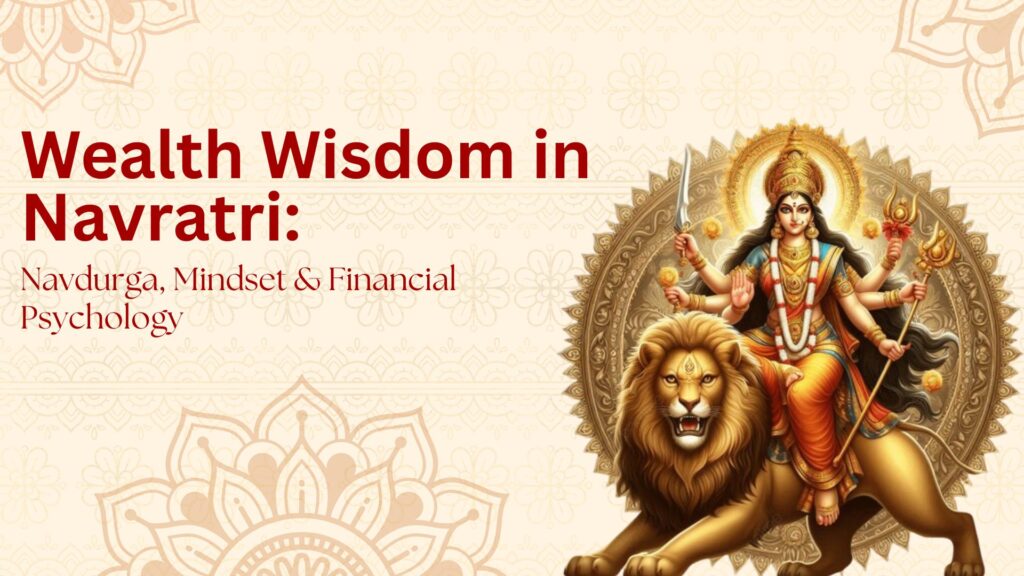
Navratri is not merely a seasonal festival—it is a cultural mirror reflecting deep psychological truths about power, resilience, balance, and renewal. As we honor the nine avatars of Durga, each day offers a symbolic lesson for how one might think about wealth, protection, growth, and purpose. In this essay, I draw on the nine forms of wealth wisdom outlined in the recent Economic Times article (The Economic Times) and interweave them with insights from behavioral finance, especially emphasizing the importance of money mindset in shaping financial behavior.
Foundations of Wealth: Discipline, Protection, Balance
The Navdurga’s first forms—Shailaputri and Brahmacharini—emphasize that discipline and protection must undergird every financial journey. Shailaputri’s symbolism of steadiness and rooted strength teaches us that a disciplined financial foundation—consistent saving, budgeting, avoiding impulsive debt—is non-negotiable. Without discipline, even high income can dissipate through careless decisions. Brahmacharini signals the role of protection: insurance, legal safeguards, emergency funds. These are the guardrails that prevent your wealth from being swept away by unforeseen events.
Behavioral finance tells us that many individuals underestimate tail risks because losses hurt more than gains please us (loss aversion). The Navdurga avatars remind us to internalize protection as a virtue, not a cost.
Growth & Opportunity: Risk, Compounding, Foresight
The middle avatars—Chandraghanta, Kushmanda, Skandamata—highlight the art of measured risk, compounding, and generational thinking. Chandraghanta stands for balancing risk and reward: too much risk invites volatility; too little stifles growth. In financial portfolios, this translates to a mix of liquid assets, growth funds, and alternative investments. Kushmanda embodies creativity and expansion. She teaches that capital should be put to work with vision—investing not just for returns but aligned with future purpose. Compounding, as we know from financial science, rewards time and steady investments, not aggressive speculation. Skandamata, the mother of Skanda, represents succession and foresight. True wealth is not only built, but passed on wisely. In modern families, this means educating heirs about money, establishing governance, and embedding values. From a mindset perspective, many people hoard or delay investment until the “perfect time.” These Navdurga lessons argue for timely, informed participation—even in uncertain times—with an eye on legacy.
Resilience, Preparedness & Purpose
In the later avatars—Katyayani, Kalaratri, Mahagauri, and Siddhidatri—we find wisdom for adversity, discipline of purpose, and fulfillment. Katyayani signifies perseverance in adversity. Financial journeys will always confront volatility, regulatory upheavals, or market corrections. Persistence paired with flexibility distinguishes temporary stops from permanent derailments. Kalaratri ushers us to confront the unknown. Black swan events (pandemics, system shocks) demand stress-tested portfolios, liquidity buffers, and backup plans. Accepting uncertainty is part of the goddess’s fierce compassion. Mahagauri embodies purity of purpose. Accumulated wealth should align with values— philanthropy, sustainable investment, giving back. Money, when structured around values, becomes a force multiplier for impact. Finally, Siddhidatri confers wisdom and fulfillment. True prosperity is not an end in itself but a tool—security, opportunity, legacy. The article argues that wealth’s highest form is in harmonizing purpose, family values, and asset allocation.
Psychology, Mindset & Behavioral Alignment
Beyond the structural lessons, the true challenge lies in psychology. Even with perfect plans and asset allocation, many fall prey to biases, emotional decisions, and inconsistent habits.
- Scarcity vs. Abundance Mindset: Many households operate from a place of scarcity—even when resources exist. Navratri’s symbolism calls us to shift into an abundance mindset, seeing possibilities rather than deficits.
- Delayed Gratification: Rituals of discipline in Navratri (fasting, penance) mirror what wealth habits require. Instead of instant consumption, financial discipline asks us to delay small pleasures for larger outcomes.
- Rituals and Anchors: Just as devotees observe rituals each day, finance too benefits from built-in rituals—quarterly reviews, yearly goal-setting, expense audits. They anchor behavior and reduce decision fatigue.
- Emotional resilience: During periods of fear (market downturns) or greed (bull runs), the inner narrative often sabotages rationality. The Durga symbolism—fierce yet balanced—teaches us to embrace emotional equilibrium.
- Identity & Money Beliefs: The hardest habits to break are the stories we tell ourselves—“I am not an investor,” “Money is dangerous,” “Wealth is for others.” Navdurga invites a reimagination: one can be fierce, wise, disciplined, and prosperous.
Pathways to Incorporate Navratri Wisdom in Everyday Finance
- Begin each financial year with introspection: invoke a Navdurga principle (e.g., day one for discipline, day five for legacy) as a mental theme.
- Build a ritual: monthly budgeting review as “offering to your financial goddess.”
- Use lenses: before every major decision, ask which goddess principle it aligns with—risk-balanced, protection, purpose, legacy.
- Incorporate giving: set aside a small portion for charity or social good—Mahagauri’s lesson of purity through giving.
- Engage family: discuss financial goals collectively; embed shared values so collaboration becomes as natural as ritual.
Conclusion: Navdurga as a Lens for Holistic Wealth
In inviting Navdurga into our financial lives, we transcend mere commodity accumulation. We learn discipline (Shailaputri), protection (Brahmacharini), balance (Chandraghanta), growth (Kushmanda), foresight (Skandamata), perseverance (Katyayani), preparedness (Kalaratri), purity of purpose (Mahagauri), and wisdom (Siddhidatri). These nine forms of wealth wisdom form a holistic compass guiding not just what to accumulate, but how to think, feel, and act with money across life’s cycles.
As a behavioral finance educator, I encourage every reader to let the spirit of Navratri awaken not only devotion but deep financial consciousness. When belief, discipline, emotion, and purpose align, abundance becomes not just possible—it becomes sustainable, meaningful, and shared with those we love.
May this Navratri inspire not just financial rituals, but a transformation of mindset, a reorientation of purpose, and a journey toward prosperous families and legacies.
ॐ जय माँ शक्ती।