
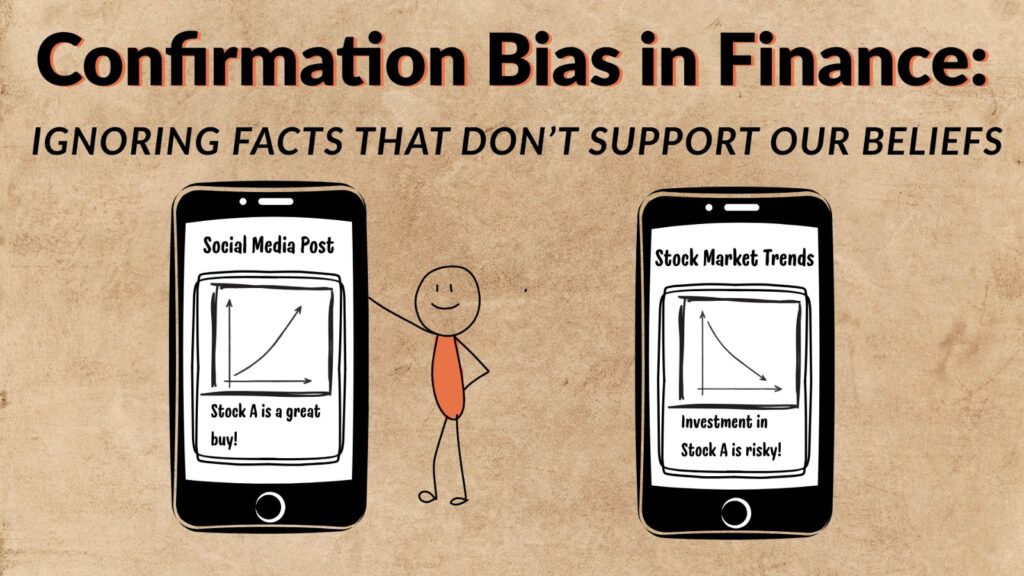
Imagine a person who firmly believes that a particular diet is the healthiest way to live. When searching online, they click only on articles that support their view, ignoring medical studies or expert advice suggesting otherwise. Over time, their belief becomes more deeply entrenched—not because it is correct, but because they have surrounded themselves with confirming information.
This is a classic case of confirmation bias, a psychological phenomenon where individuals selectively gather or interpret information in a way that reinforces their existing beliefs. First defined by psychologists Festinger (1957) and expanded by Lord, Ross, and Lepper (1979), confirmation bias explains why people often overlook facts that contradict their opinions, and instead seek validation—even when doing so can be harmful.
In the world of investing, confirmation bias is especially dangerous. Investors tend to favor information that supports their investment decisions while dismissing warning signs or contrary evidence. According to Shefrin (2000), this cognitive distortion results in poor portfolio management, delayed exit from underperforming stocks, and excessive confidence in chosen strategies.
For instance, an investor may be deeply optimistic about the prospects of the Indian real estate sector. As a result, they actively consume only positive news about the sector—such as reports on infrastructure spending or housing demand—while ignoring data on rising interest rates, project delays, or regulatory bottlenecks. Over time, this one-sided view can lead to overexposure to a single sector and significant portfolio risk.
The Association of Mutual Funds in India (AMFI) notes that retail investors often under-diversify their portfolios, favoring familiar sectors or companies despite clear evidence that diversification reduces risk. This behavior is frequently driven by confirmation bias. Similarly, SEBI’s Investor Education Portal warns investors about psychological traps that can impair decision-making and urges the use of facts and risk metrics in portfolio planning.
Academic literature consistently shows how confirmation bias distorts investment judgment. A study by Barber and Odean (2001) found that overconfident investors—typically influenced by confirmation bias—trade more frequently and underperform the market. Additionally, Nickerson (1998) highlighted that this bias slows learning because individuals stop seeking disconfirming evidence once their belief feels validated.
The dangers are not limited to individuals. Entire investor communities or social media groups can become echo chambers, reinforcing shared views and excluding contradictory data. In such environments, sentiment-driven trading increases, sometimes at the cost of fundamentals, as observed in market cycles influenced by hype and speculation.
How to Overcome Confirmation Bias:
- Seek Contradictory Information: Make it a habit to explore opposing viewpoints before making financial decisions.
- Use Objective Tools: Employ data-driven metrics like P/E ratios, risk-adjusted returns, and volatility measures to evaluate investments.
- Consult Independent Advisors: A qualified financial advisor can provide unbiased insights and challenge preconceptions.
- Regular Portfolio Reviews: Periodic assessments help identify hidden risks and reduce concentration based on outdated assumptions.
In conclusion, confirmation bias is subtle but powerful. It can distort perception, cloud judgment, and derail long-term financial goals. As emphasized by SEBI’s investor awareness campaigns, rational and balanced decision-making is the cornerstone of smart investing. Awareness is the first step toward behavioral discipline—and ultimately, better financial outcomes.
Are your investment decisions rooted in facts—or filtered by your beliefs?
Take the first step toward unbiased, evidence-based investing.
Reach out via www.meghnadangi.com or message directly on LinkedIn at #MoneyWithMeghna.
Let’s turn behavioral awareness into better investment outcomes.
References (APA Style)
Barber, B. M., & Odean, T. (2001). Boys will be boys: Gender, overconfidence, and common stock investment. The Quarterly Journal of Economics, 116(1), 261–292. https://doi.org/10.1162/003355301556400
Festinger, L. (1957). A theory of cognitive dissonance. Stanford University Press.
Lord, C. G., Ross, L., & Lepper, M. R. (1979). Biased assimilation and attitude polarization: The effects of prior theories on subsequently considered evidence. Journal of Personality and Social Psychology, 37(11), 2098–2109. https://doi.org/10.1037/0022-3514.37.11.2098
Nickerson, R. S. (1998). Confirmation bias: A ubiquitous phenomenon in many guises. Review of General Psychology, 2(2), 175–220. https://doi.org/10.1037/1089-2680.2.2.175
Shefrin, H. (2000). Beyond greed and fear: Understanding behavioral finance and the psychology of investing. Harvard Business School Press.
SEBI. (n.d.). Investor Awareness Initiatives. Securities and Exchange Board of India. https://www.sebi.gov.in
AMFI. (n.d.). Investor Education Portal. Association of Mutual Funds in India. https://www.amfiindia.com
The Economic Times. (2024). Real estate and infrastructure sectors face headwinds amid macro volatility. https://economictimes.indiatimes.com
Disclaimer:
This article is for educational and informational purposes only and does not constitute investment advice or a recommendation. The views expressed are based on the author’s personal research and expertise in behavioral finance and wealth management, and are not affiliated with or endorsed by any mutual fund house or financial product provider. Professor (Dr.) Meghna Dangi is not a SEBI-registered investment advisor. These are not promotional endorsements of any specific brand or financial institution.