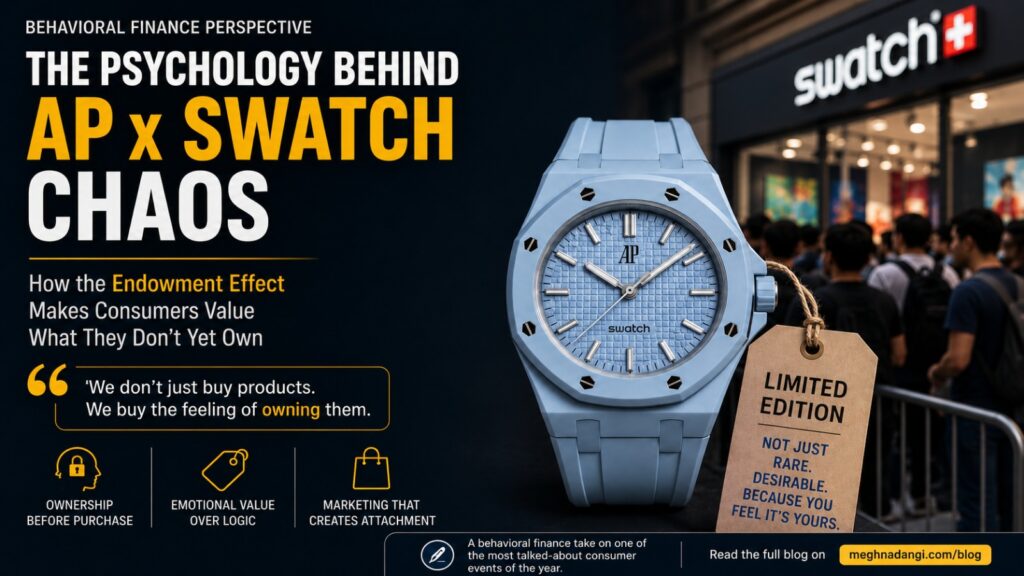
Beyond Scarcity: Understanding the Real Psychology
The recent launch of the AP x Swatch “Royal Pop” collection created scenes rarely associated with a wristwatch launch. Across cities such as Mumbai, Delhi, London and Dubai, consumers queued overnight, stores struggled with crowd control, police intervention became necessary, and videos of chaotic queues spread rapidly across social media platforms. The incident was largely interpreted as another example of “scarcity marketing.” However, from the perspective of behavioral economics and market psychology, the deeper explanation lies elsewhere.
The episode represents a powerful demonstration of the Endowment Effect combined with Herding Bias — two behavioral tendencies that modern marketers increasingly use to influence consumer decision-making. The most interesting aspect of the launch was that many consumers appeared emotionally attached to the product long before purchasing it. This is precisely where the Endowment Effect becomes relevant.
The Endowment Effect: Ownership Before Purchase
The Endowment Effect, popularised through the work of behavioral economists such as Richard Thaler and Daniel Kahneman, explains the tendency of individuals to assign higher value to something merely because they perceive it as “theirs” or potentially “theirs”. Traditional economic theory assumes that people evaluate products rationally on the basis of utility and price. Behavioral economics, however, demonstrates that emotional attachment significantly alters perceived value.
In the AP x Swatch case, consumers were not simply evaluating a watch. Through anticipation, waiting time, social media discussions, influencer content and collective excitement, many individuals had already psychologically incorporated the product into their personal identity. By the time they reached the store, the watch was no longer an external product. It had become an imagined possession. This distinction is crucial.
How Modern Marketing Creates Psychological Ownership
Modern luxury and lifestyle marketing increasingly focuses on creating emotional attachment before financial commitment. The queue itself becomes part of the product experience. Brands understand that the more effort a consumer invests — whether through waiting, anticipation, social validation or online engagement — the stronger the psychological ownership becomes. This is why limited launches are accompanied by countdowns, waitlists, influencer previews, restricted access and carefully staged exclusivity. The objective is not merely to sell a product. The objective is to create emotional investment. From a market strategy perspective, this is highly effective because consumers begin protecting the idea of ownership even before the transaction occurs. Once this emotional transition happens, rational price comparison and objective evaluation weaken considerably. The consumer is no longer asking: “Do I need this product?” Instead, the question becomes: “What if I lose the opportunity to own it?” That shift is behaviorally significant.
Why Naive Consumers Are More Vulnerable
Behaviorally informed marketing tends to affect inexperienced or emotionally driven consumers more strongly because they confuse emotional activation with genuine preference. Consumers often assume anticipation means value, exclusivity means quality, popularity means superiority, and difficulty of access means desirability. In reality, these are carefully engineered psychological signals. Modern marketers increasingly design experiences that activate emotion first and rational evaluation later. The consumer’s attention becomes focused on obtaining access rather than objectively assessing utility. This is particularly effective in the age of social media, where ownership is publicly displayed and consumption becomes performative.
Conclusion: Creating Psychological Distance
The most effective way to overcome the Endowment Effect is to create psychological distance before making a purchase decision. Modern marketing intentionally creates emotional ownership through exclusivity, hype, queues, influencer validation and social proof. The moment consumers begin imagining a product as “theirs,” rational evaluation weakens.
A simple way to interrupt this bias is to pause and ask:
- Would I still want this product if nobody else could see me owning it?
- Am I valuing the product itself, or the social experience surrounding it?
- If this item were easily available next month, would it still feel equally desirable?
These questions help separate genuine preference from psychologically engineered desire — something increasingly important in today’s attention-driven consumer economy.
References
- The Economic Times – AP x Swatch launch chaos coverage
- The Guardian – Global crowd reactions and store shutdowns
- Business Insider – Scarcity marketing and luxury collaboration psychology
- Kahneman, D., Knetsch, J. L., & Thaler, R. H. (1991). Anomalies: The Endowment Effect, Loss Aversion, and Status Quo Bias. Journal of Economic Perspectives.
- Thaler, R. H. (1980). Toward a Positive Theory of Consumer Choice. Journal of Economic Behavior & Organization.
- Cialdini, R. (2009). Influence: Science and Practice. Pearson Education.
- Ariely, D. (2008). Predictably Irrational. HarperCollins.