
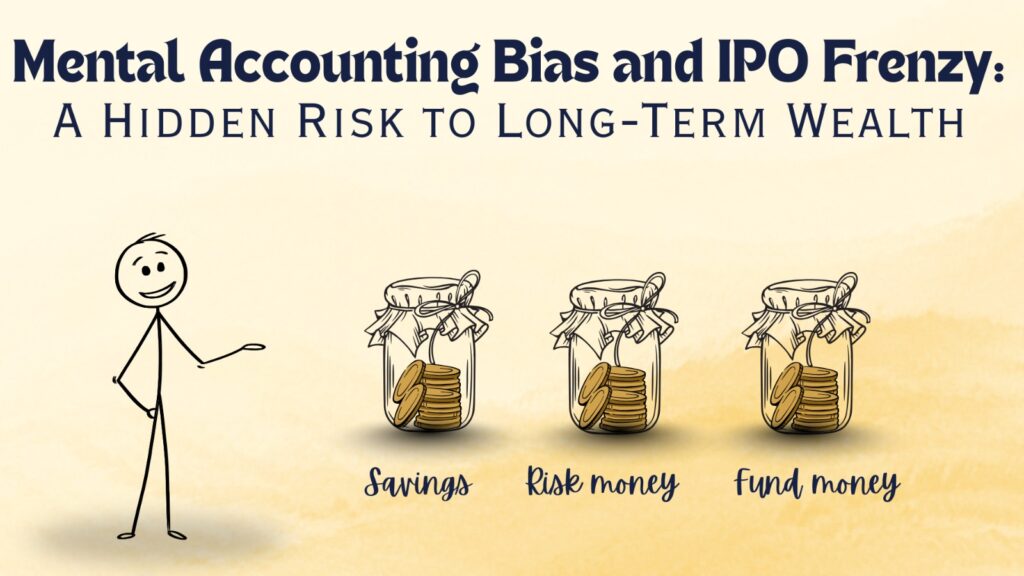
In the last few years, Indian capital markets have witnessed an IPO boom — from tech unicorns to fintech disruptors, companies have attracted retail investors in droves. While listing-day excitement and social media chatter often dominate attention, what’s less discussed is the behavioral trap behind many of these investment decisions: mental accounting bias.
This cognitive bias silently influences how investors treat money — not based on rational portfolio strategy, but based on where the money came from or how they feel about it. As a result, large sections of the investor population make emotionally charged IPO decisions that may not align with their overall financial objectives.
What Is Mental Accounting Bias?
Mental accounting, a term introduced by Nobel laureate Richard Thaler, refers to the tendency of individuals to treat money differently based on its source, purpose, or subjective labeling — even though, economically, all money is fungible.
For example:
- A work bonus is treated as “extra” money and invested in riskier assets.
- Refunds, gifts, or windfalls are mentally separated from one’s “core investments” and often spent or invested carelessly.
- IPOs are seen as “quick win” opportunities for such mentally labeled funds.
This separation violates the principle of rational investing, where all capital should be evaluated based on risk-return suitability and portfolio goals, not emotional categories.
Mental Accounting in Recent IPO Investment Behavior
A clear manifestation of mental accounting bias is visible in how investors approach IPOs.
Surveys and media reports show that many Indian retail investors apply only a small, mentally earmarked portion of their funds — often bonus income, idle cash, or one-time gains — to IPO applications. Because this pool is considered “disposable” or “non-core,” the due diligence that typically governs other investment decisions is often ignored.
A 2023 SEBI investor survey noted that nearly 40% of retail IPO investors considered their IPO applications as “one-off opportunities,” with minimal regard for valuation, fundamentals, or alignment with long-term goals. Further, these investments were rarely tracked or re-evaluated — reinforcing the psychological separation created at the point of decision-making.
Academic research echoes this behavior. Mental accounting, along with overconfidence and herding behavior, was a statistically significant predictor of speculative investment in Indian equity markets, particularly IPOs.
Why It’s Risky
This bias is subtle but dangerous.
- Diluted Risk Awareness: When money is mentally separated from “core” investments, investors feel less pain if it underperforms — which encourages higher risk-taking.
- Poor Portfolio Alignment: IPOs purchased on a whim may not align with the asset allocation, risk tolerance, or goals of the overall financial plan.
- No Exit Strategy: Since IPO investments are often not part of a disciplined framework, investors hold them aimlessly, hoping for recovery — or exit too quickly, missing long-term value creation.
What Advisors and Investors Can Do
For wealth advisors and serious investors, awareness of this bias is key. Here’s how to counter it:
Treat all capital as strategic: Regardless of whether it’s a bonus, inheritance, or surplus — evaluate each investment opportunity by the same financial principles.
Incorporate IPOs into the broader plan: Every investment, including IPOs, should be assessed in terms of risk, time horizon, and role in the overall portfolio.
Educate clients (and yourself): Behavioral coaching is as essential as portfolio construction. Advisors should routinely discuss biases like mental accounting with clients during review meetings.
Track IPO performance objectively: Maintain transparency with clients on IPO allocations, returns, and comparisons to the broader market. Emotional decisions thrive in data-free zones.
Final Thoughts
As I highlight in my book The Behavioral Finance Way – A Practical Guide to Mindful Investing, investing mindfully means not just choosing the right products, but also understanding the psychology behind those choices.
Mental accounting bias may seem harmless — after all, what’s wrong with investing “just a little extra” in an IPO? But when repeated across market cycles, these small behavioral missteps compound into significant portfolio inefficiencies.
If you’ve ever heard yourself or your client, say, “This is just IPO money” — pause. That statement reveals more than intent; it reveals a hidden risk to wealth creation.
Disclaimer:
This article is for educational and informational purposes only and does not constitute investment advice or a recommendation. The views expressed are based on the author’s personal research and expertise in behavioral finance and wealth management, and are not affiliated with or endorsed by any mutual fund house or financial product provider. Professor (Dr.) Meghna Dangi is not a SEBI-registered investment advisor. These are not promotional endorsements of any specific brand or financial institution.