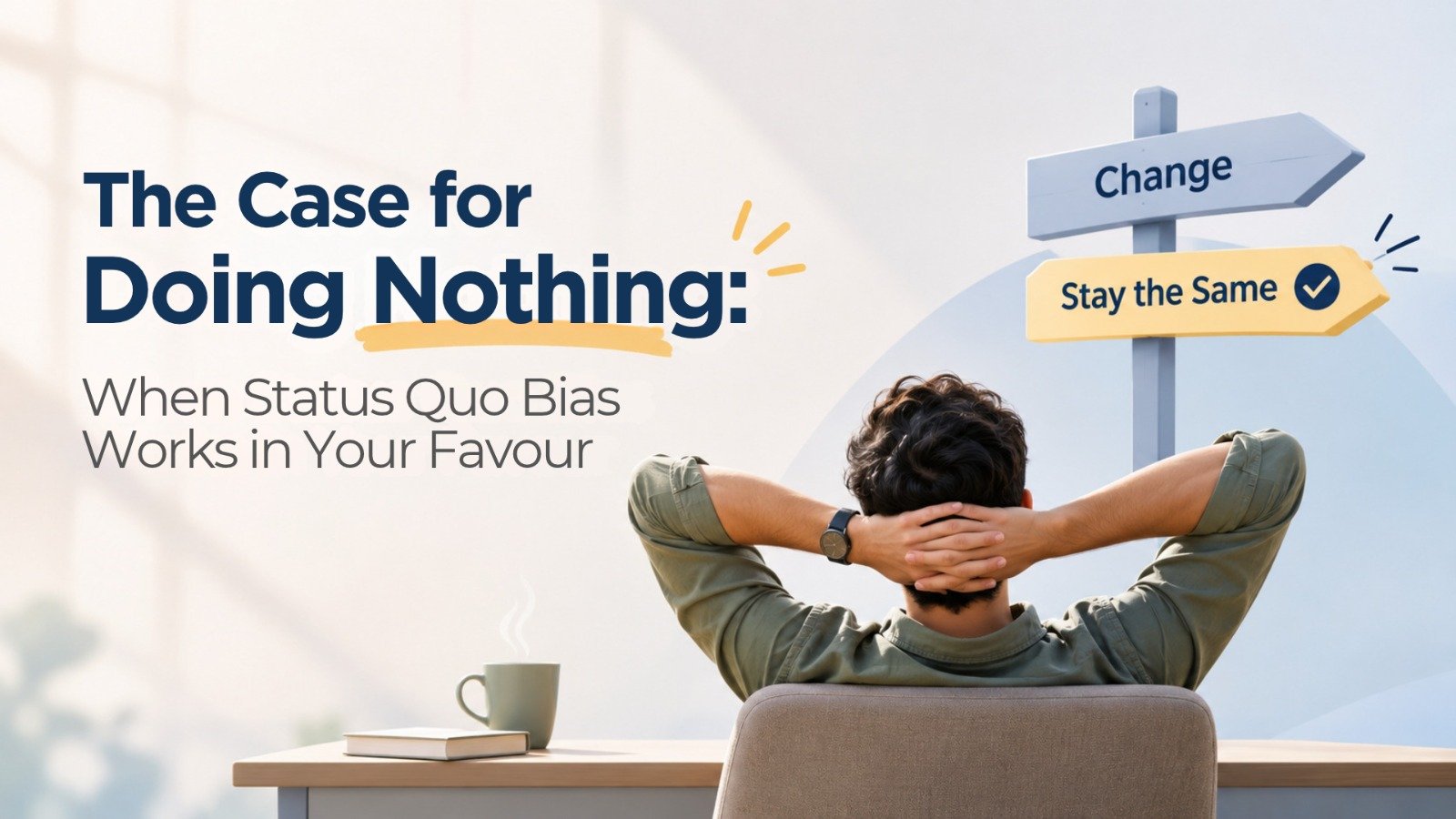
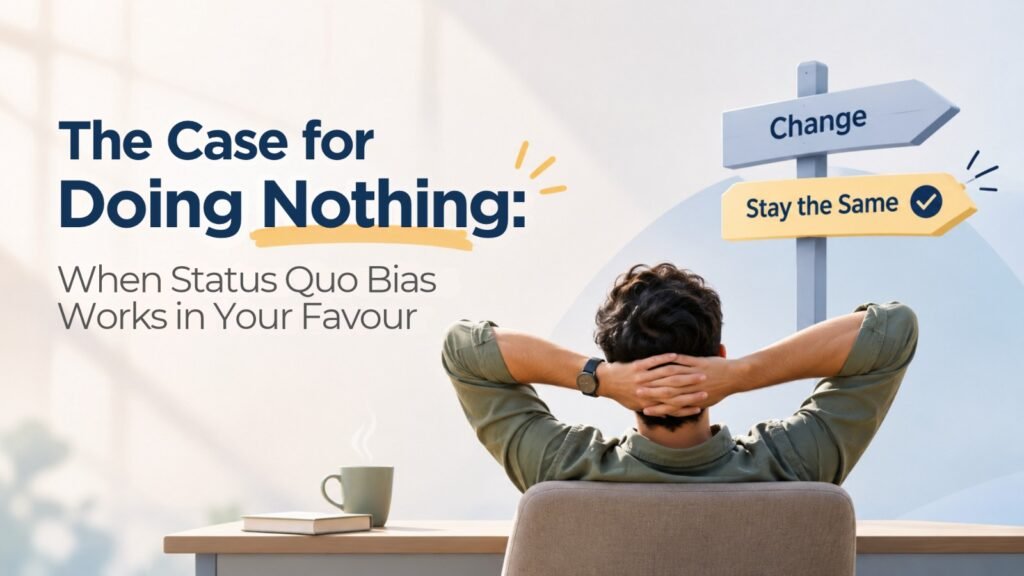
We like to believe we make choices all day. In practice we make far fewer. We keep the same bank, the same route to work, the same phone plan and the same portfolio, because changing feels like effort and risk while staying feels like nothing. Behavioral finance calls this status quo bias. It is usually filed among the errors of thinking, but the picture is more nuanced: the bias can quietly protect us or quietly cost us, depending on what we are staying with.
What the Research Says
In a series of experiments, researchers found that individuals disproportionately stick with the status quo, meaning their current or previous choice or simply doing nothing. This held across decisions as varied as investment portfolios and health plans [1].
Why We Stay Put
Several forces work together:
- Loss aversion. Researchers showed that we judge any change against our current position, and that what we would give up looms larger than what we would gain. Owning something also makes it feel more valuable [2].
- Omission bias and regret. Harm caused by action feels worse than the same harm caused by inaction. Researchers found that people avoided acting even when acting reduced risk [3]. Doing nothing feels safer to defend.
- Effort and uncertainty. Comparing options takes mental energy, and the alternative is always less known than the present. Staying costs no effort.
In Life
Few studies show the effect better than research on organ donation. Where people had to opt in, consent was about 4% in Denmark. Where they had to opt out, it was nearly 100% in Austria [4]. The citizens were not so different. The default was. The same pattern shapes the jobs we remain in, the subscriptions we never cancel and the insurance we never review.
In Investing: The Cost of Staying
The bias does harm when a losing holding is kept because selling would make the loss real, when an inherited portfolio is left untouched for decades, or when a fund, an insurance plan or an allocation is carried along simply because it has always been there. “Unchanged for years” gets mistaken for “chosen.”
The Bright Side of Staying Put
Status quo bias is not only a flaw. Staying put saves mental energy for the decisions that matter, and it spares us the costs and taxes of constant change. Under uncertainty it can even be sensible. Researchers have shown that people unsure how a change will affect them may rationally resist reforms that would help, because the downside of a wrong move is real while the upside is unknown [5]. The evidence from markets is striking. A large study of household brokerage accounts found that those who traded most earned markedly lower net returns than those who traded least [6]. Inertia keeps compounding unbroken and keeps emotion away from the controls. The bias is neutral. It strengthens whatever the default is, so a sound plan gains from it.
A Week That Tested the Bias
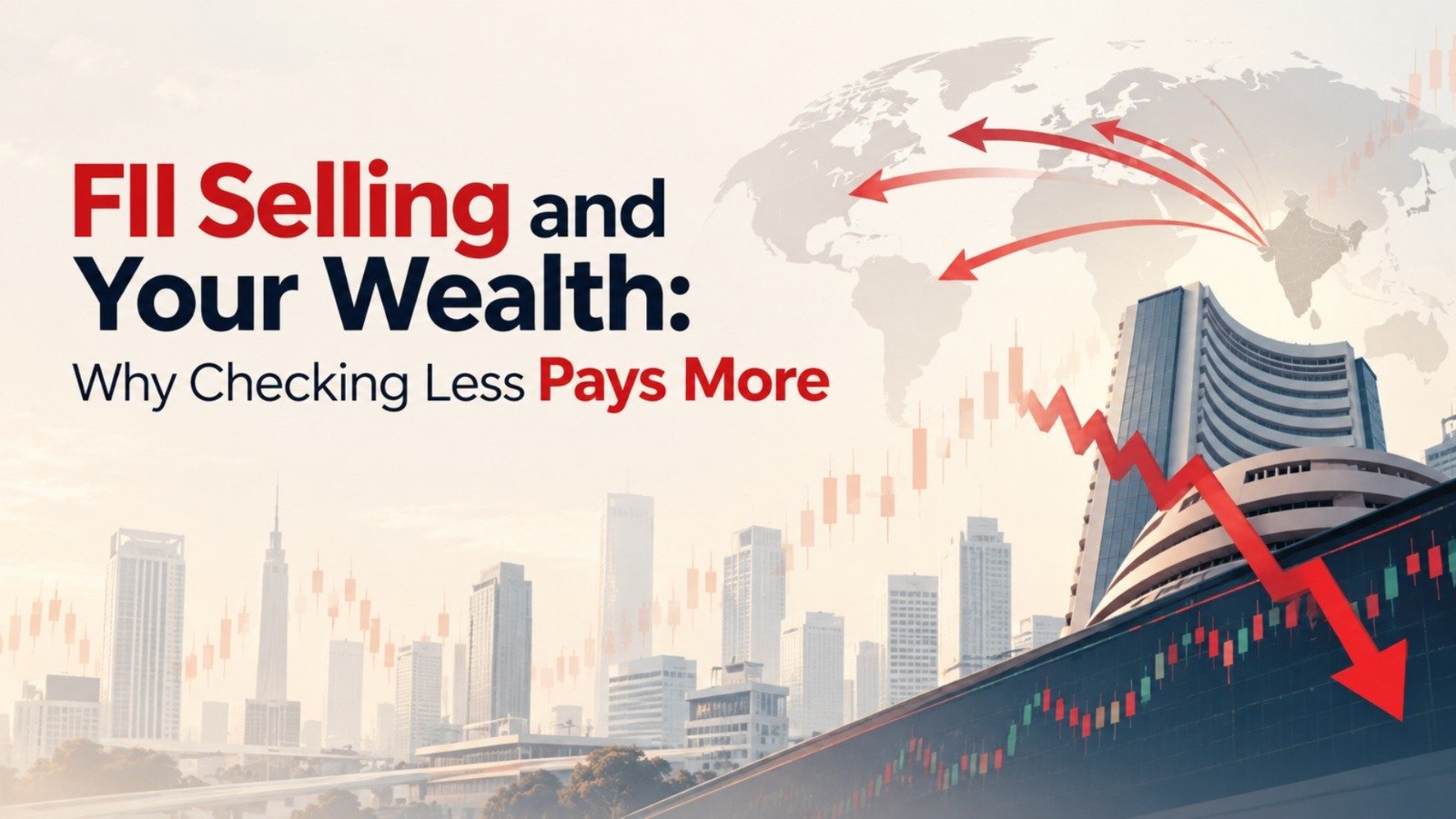
This week’s markets made the case. On Thursday the Nasdaq Composite closed nearly 12% below its 6 October record, and the S&P 500 technology sector fell 7.3% in a day, its biggest drop in more than six years. The Fed raised rates in September, its first increase in three years, and futures imply about an 80% chance of another in December [7]. Yet in India the Nifty 50 rose 8.6% in the week to 6 November, its strongest week in nearly six years, as Brent crude fell more than 16% and foreign investors bought ₹45,960 crore of equities, more than the ₹45,162 crore withdrawn in October [8]. An investor with a sound allocation had one job: do nothing. Reshuffling in response to the US sell-off would have meant reacting to a story that moved India the other way, and leaving India in October would have meant missing its best week in years. Whether this marks a turning point is unknowable.
Making Inertia Work for You
- Set the default on purpose. Automate contributions and agree annual step-ups in advance.
- Write your allocation down. When your plan says “do nothing unless the weights drift past a set band,” inaction is the plan.
- Separate inertia from neglect. Review once a year against your goals, not against headlines.
- Add friction to exits. Wait 48 hours before any large reversal.
- Ask the counter-question. If you had cash today, would you choose this holding again? If not, change it.
Doing nothing is a strategy only when the plan you are not changing is a good one. The work lies in building that plan calmly, so that staying put is a decision you made rather than one you drifted into.
References
- Samuelson, W., & Zeckhauser, R. (1988). “Status Quo Bias in Decision Making.” Journal of Risk and Uncertainty, 1(1), 7–59.
- Kahneman, D., Knetsch, J. L., & Thaler, R. H. (1991). “Anomalies: The Endowment Effect, Loss Aversion, and Status Quo Bias.” Journal of Economic Perspectives, 5(1), 193–206.
- Ritov, I., & Baron, J. (1990). “Reluctance to Vaccinate: Omission Bias and Ambiguity.” Journal of Behavioral Decision Making, 3(4), 263–277.
- Johnson, E. J., & Goldstein, D. (2003). “Do Defaults Save Lives?” Science, 302(5649), 1338–1339.
- Fernandez, R., & Rodrik, D. (1991). “Resistance to Reform: Status Quo Bias in the Presence of Individual-Specific Uncertainty.” American Economic Review, 81(5), 1146–1155.
- Barber, B. M., & Odean, T. (2000). “Trading Is Hazardous to Your Wealth: The Common Stock Investment Performance of Individual Investors.” Journal of Finance, 55(2), 773–806.
- “Wall St Week Ahead: As tech swoon roils market, US inflation data on tap.” Khaleej Times, 8 November 2026. khaleejtimes.com
- Kotak Neo. “FII Inflows Surge to ₹45,960 Crore in a Week as Nifty Rallies 8.6%; What’s Behind the Rise?” 8 November 2026. kotakneo.com
Disclaimer: This article is for educational and informational purposes only and does not constitute investment advice or a recommendation to buy, sell, or hold any security.
The views expressed are based on the author’s research and expertise in behavioral finance and wealth management.
Prof. Dr. Meghna Dangi is not a SEBI-registered investment advisor