At first glance, this appears to be a simple investment philosophy. However, when examined through the lens of behavioural finance, it represents a deeper truth about wealth creation — successful investing is not only about choosing the right investments; it is about creating the right decision-making framework. Markets are uncertain. Returns are unpredictable. Investor emotions, however, are predictable. History has repeatedly shown that the biggest challenge for investors is not always identifying opportunities but remaining disciplined when markets behave differently from expectations.
As Daniel Kahneman and Amos Tversky demonstrated through their pioneering work in behavioural economics, human beings do not always make decisions through pure rationality. Emotions, experiences and mental shortcuts influence financial decisions. Therefore, a successful investment journey requires an architecture that reduces dependence on emotions. That architecture begins with two principles: Allocate by Rule. Endure by Design.
Allocate by Rule: Creating Investment Discipline Before the Market Tests You
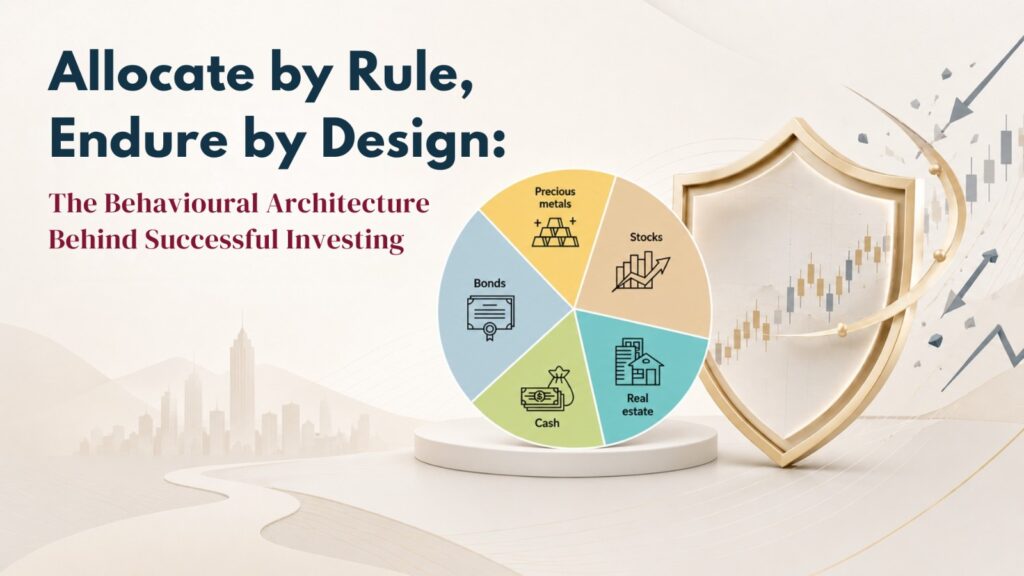
Asset allocation is arguably the most important investment decision an investor makes. However, many investors approach allocation reactively. They increase exposure to assets that have recently performed well and reduce exposure after experiencing volatility. This creates a paradox: Investors often buy more after prices have risen and become uncomfortable after prices fall. A rule-based allocation approach solves this problem by creating a decision framework before emotions enter the process. Rules convert investing from a reaction-driven activity into a process-driven activity.
Rule 1: Start with goals, not products
Every investment decision should begin with a question: What is this money meant to achieve? An investment portfolio should be a reflection of financial goals, time horizons and responsibilities. A retirement portfolio, a child’s education goal and an emergency fund require different approaches because their purpose, liquidity requirements and timelines are different.The product should follow the goal — not the other way around.
Rule 2: Allocate based on risk capacity, not temporary emotions
Investors often confuse risk appetite with risk capacity. Risk appetite is the amount of volatility an investor believes they can tolerate. Risk capacity is the actual financial ability to withstand volatility. A proper allocation framework considers:
- Investment horizon
- Income stability
- Liquidity requirements
- Financial responsibilities
- Ability to recover from market declines
The right portfolio is not the one that produces the highest return in ideal conditions. It is the one that an investor can remain committed to across different market cycles.
Rule 3: Define rebalancing rules
Markets constantly change the relationship between asset classes. A strong equity rally may increase equity exposure beyond the intended level. A prolonged correction may reduce it significantly. Rebalancing creates discipline by restoring the original allocation framework. It forces investors to systematically:
- Reduce exposure where valuations have increased significantly
- Increase exposure where opportunities emerge
Instead of asking: “Where will the market go next?” The investor follows: “What does my investment process require me to do?”
Endure by Design: Building a System That Investors Can Live With
Investing is not only a decision-making exercise. It is a behaviour-management exercise. Many investment strategies fail not because the strategy was wrong, but because investors could not remain committed during difficult periods. “Endure by design” means creating a portfolio and process that can survive uncertainty. The objective is not to remove volatility. The objective is to create a structure where volatility does not force poor decisions.
Design 1: Create a portfolio aligned with human behaviour
A mathematically optimal portfolio may not always be the most suitable portfolio. An investor may intellectually understand the benefits of equity investing, but if the portfolio creates excessive discomfort during market declines, the probability of abandoning the strategy increases. Therefore, portfolio design must consider:
- Emotional comfort with fluctuations
- Ability to remain invested during corrections
- Need for liquidity
- Personal financial circumstances
The best portfolio is not only financially efficient. It is behaviourally sustainable.
Design 2: Reduce unnecessary decision points
Markets constantly provide information, opinions and predictions. Every headline creates a potential decision. However, excessive decision-making often creates excessive mistakes. A well-designed investment process includes:
- A written investment philosophy
- Defined review periods
- Clear decision rules
- Goal-based monitoring
The purpose is to ensure that decisions are made during calm periods rather than emotional periods.
Design 3: Separate market movement from investment progress
A common mistake is measuring investment success only through short-term market movements. A long-term investor should evaluate:
- Whether goals are progressing
- Whether the allocation remains appropriate
- Whether the original investment thesis remains valid
Short-term market noise should not automatically become a long-term investment decision.
Compound by Default
The final phrase — “Compound by default” — is the outcome of the first two principles. Compounding does not require constant intervention. It requires:
- Capital allocated intelligently
- Time spent in the market
- Discipline maintained through cycles
When investors allocate through rules and endure through design, compounding gets the environment it needs to operate. The investor’s responsibility is not to force compounding. The investor’s responsibility is to create the conditions where compounding can happen naturally.
Conclusion: Wealth Creation Is a Process Before It Is a Return
Successful investing is not created only by selecting investments. It is created by designing a system. “Allocate by rule” ensures that decisions are based on principles rather than emotions. “Endure by design” ensures that investors remain committed when uncertainty arrives. And when these two foundations are strong, “compound by default” becomes the natural outcome. The greatest advantage an investor can create is not the ability to predict every market movement. It is the ability to build a process strong enough to survive every market movement.
References
- Kahneman, D. (2011). Thinking, Fast and Slow. Farrar, Straus and Giroux.
- Kahneman, D., & Tversky, A. (1979). “Prospect Theory: An Analysis of Decision under Risk.”
- Thaler, R. H. (2015). Misbehaving: The Making of Behavioral Economics.W. Norton.
- Odean, T. (1999). “Do Investors Trade Too Much?” American Economic Review.
- Siegel, J. (2022). Stocks for the Long Run. McGraw-Hill.