On June 15, 2026, global financial markets exhaled. President Trump and Iran announced an initial agreement — the “Islamabad MOU” — to end the conflict, reopen the Strait of Hormuz, and pave the way for nuclear negotiations. The S&P 500 rose 1.9% within hours. Brent crude, which had been trading near $87–$109 per barrel at various points during the conflict, dropped nearly 5% on the day. Indian equity markets, sensitive to both crude prices and global risk sentiment, responded with relief.
And yet — what were investors actually responding to? A signed agreement? A 60-day ceasefire extension? A draft memorandum with critical issues still unresolved?
This is precisely where behavioral finance offers its most instructive lens.
The Geopolitical Event and What It Means for India
For India, the US-Iran conflict has not been a distant geopolitical story. India imports approximately 85–90% of its crude oil requirements, and the Strait of Hormuz remains one of the world’s most critical energy arteries. When military strikes on Iran in February–March 2026 pushed Brent crude above $100 per barrel and the Sensex corrected sharply, the transmission mechanism was clear: higher oil prices increase India’s import bill, widen the current account deficit, fuel inflation, and constrain the Reserve Bank of India’s monetary policy options. Aviation, logistics, oil marketing companies, and consumption-linked sectors all faced compounded uncertainty.
Conversely, the peace deal — even a preliminary one — carries real economic implications. A sustained reduction in crude prices, should the Strait of Hormuz reopen fully, could meaningfully reduce inflationary pressure in India, create headroom for rate adjustment, and improve Foreign Institutional Investor (FII) flows into Indian equities. Sectors that were battered during the conflict cycle — aviation, OMCs, consumer staples — stand to benefit from a sustained de-escalation.
This is the fundamental economic reality. But markets did not wait for confirmation. They moved on the narrative.
When Markets Price Stories, Not Facts
The distinction I want to draw here is subtle but consequential: markets are not driven purely by information. They are driven by the interpretation of information — and that interpretation is shaped profoundly by human psychology.
When the US-Iran deal was announced, three groups of investors existed simultaneously in the market.
The first group turned optimistic: “Peace means crude falls, inflation cools, the RBI can cut rates, FIIs will return, and markets will rally.” They moved to add risk.
The second group turned cautious: “This is a 60-day ceasefire with unresolved nuclear issues, Trump linking it to the Abraham Accords, and a history of failed agreements. Nothing has fundamentally changed.” They stayed defensive.
The third group turned overconfident: “I knew peace was coming. I had positioned for this.” They began attributing foresight to what was, in reality, fortunate timing.
The same event. Three entirely different responses. This is not a feature of irrational markets — it is a feature of human cognition interacting with uncertainty. Being informed and being influenced are not the same thing, and this distinction deserves serious reflection from every investor.
The Deeper Cognitive Architecture Behind “Peace Rally” Behavior
Let us go beyond the familiar vocabulary of fear and greed, and examine the specific cognitive patterns at play.
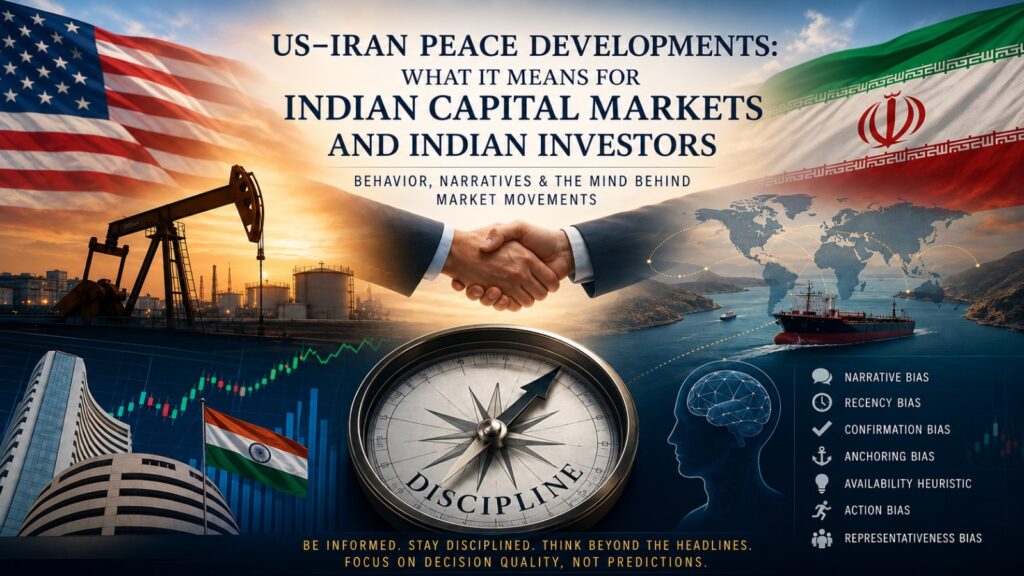
Narrative Bias is perhaps the most prevalent here. Investors, confronted with a complex geopolitical development, instinctively reduce it to a simple causal story: peace → lower oil → lower inflation → rate cuts → equity rally. Each link in this chain is plausible, but the chain itself is a cognitive construct, not a guaranteed sequence. Narrative bias leads investors to invest in the story rather than interrogate the underlying fundamentals — including the fact that the deal remains provisional, nuclear issues are deferred, and geopolitical risk premiums rarely dissolve overnight.
Recency Bias amplifies this. After months of living under the shadow of elevated oil prices and market volatility, investors overweight the most recent data point — a peace announcement — and assume it marks a clean discontinuity. The mind treats a ceasefire as a resolution. Historical precedent, from the 2015 Iran nuclear deal to intermittent Middle East negotiations over decades, suggests that markets frequently overshoot on both the downside and the upside in response to such signals.
Anchoring Bias adds another layer. Investors who observed Sensex levels before the conflict began, or crude prices at $60–$65 per barrel from early 2026, tend to anchor their expectations to those reference points. “Markets will go back to where they were” is an anchoring statement masquerading as analysis. Markets do not return to previous levels simply because those levels existed — they return when the underlying earnings, liquidity, and risk conditions justify it.
Representativeness Bias leads investors to assume that because previous geopolitical resolutions have preceded market rallies — Kargil in 1999, the 2013 Iran nuclear interim agreement — this one will too. But each geopolitical event carries a unique economic and structural context. Pattern-matching across events without controlling for fundamental differences is a well-documented source of judgment error.
Action Bias deserves particular attention. Under uncertainty, the human brain experiences a strong compulsion to do something — rebalance, rotate, hedge, or deploy. Action feels like control. But when the underlying situation remains genuinely uncertain, as it does with an initial US-Iran agreement that leaves nuclear issues, sanctions relief, and regional dynamics as open questions, premature action often crystallizes costs rather than capturing opportunity.
Finally, the Availability Heuristic explains why a dramatic headline — “US and Iran Sign Peace Deal at Versailles” — receives disproportionate cognitive weight. Vivid, emotionally salient news occupies more mental bandwidth than its actual probability-adjusted impact warrants. The probability that this deal transitions smoothly to a permanent agreement, with full Hormuz reopening, sanctions lifted, and regional stability achieved, is meaningfully uncertain. Yet the announcement alone changes investor positioning in ways that suggest near-certainty.
The Indian Investor: What This Moment Actually Demands
For Indian investors, the US-Iran peace process is neither uniformly good news nor a cause for alarm. It is an opportunity to examine the quality of their own decision-making.
Long-term wealth creation does not require predicting which geopolitical events will unfold, or getting the first move right on peace deals and conflict escalations. It requires something more demanding and more durable: separating global headlines from personal financial goals.
India’s structural growth story — its demographic dividend, consumption expansion, financial inclusion depth, and technology-driven productivity — remains intact regardless of whether the Strait of Hormuz is fully reopened in sixty days or sixty months. The businesses underlying your portfolio do not change their earnings trajectory based on a memorandum of understanding signed in Versailles, unless you allow portfolio disruptions triggered by that news to permanently alter your investment timeline.
What this moment demands is not a tactical view on crude. It demands a review of process. Ask: Am I making this decision based on my financial goals, risk appetite, and asset allocation framework? Or am I making it because a headline has created a narrative that feels compelling?
The difference between those two questions is the difference between being informed and being influenced.
Conclusion: The Invisible Risk
Markets have survived wars, sanctions, failed negotiations, and geopolitical upheavals across every decade of their existence. The Indian equity market rallied after Kargil, recovered after the 2008 financial crisis, absorbed demonetization, and withstood a pandemic. It will absorb the uncertainty of an initial US-Iran agreement, too.
But what markets cannot protect you from is the invisible risk: the unchecked influence of your own cognitive biases while interpreting events that feel unprecedented, urgent, and decisive.
The biggest threat to your portfolio today is not crude at $87 or the Strait of Hormuz. It is the narrative you construct around those facts — and the portfolio actions you take based on that narrative rather than on the fundamentals of your own financial plan.
In behavioral finance, we call this the gap between stimulus and response. Geopolitics provides the stimulus. Cognitive biases shape the response. Disciplined, self-aware investing is the only mechanism that narrows that gap.
The Strait of Hormuz may reopen. Inflation may ease. Markets may rally. Or the 60-day window may give way to fresh uncertainty. We do not know. And crucially, neither does the market.
What you can know is your own investment process — and whether it is built on evidence, or on stories