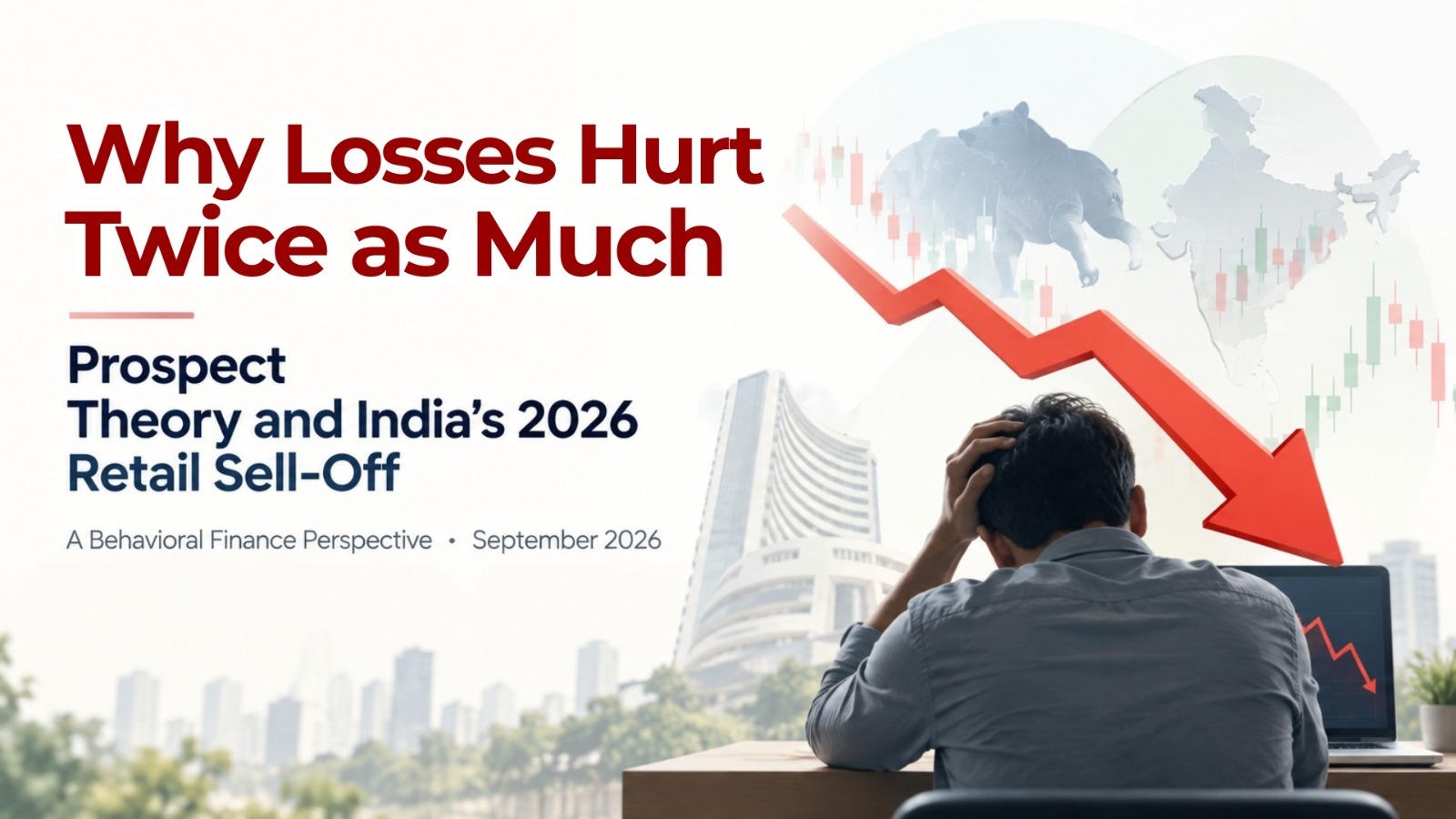

The events of March 2026 offered a compelling setting to examine investor behavior under stress. A record Foreign Institutional Investor (FII) outflow of ₹1.14 lakh crore coincided with a sharp market correction, eroding nearly ₹51 lakh crore in investor wealth. Yet, even as global capital exited, domestic investors continued to deploy funds, with sustained SIP inflows and strong participation from Domestic Institutional Investors (DIIs). This divergence raises a fundamental behavioral question: does persistence in such environments reflect rational discipline, or does it signal psychological entrapment?
Commitment, in its classical sense, is a cornerstone of successful investing. Long-term wealth creation often depends on the ability to remain invested through cycles of volatility, guided by a coherent investment thesis. However, behavioral finance compels us to recognize that commitment is not inherently virtuous. It possesses a dual character. While one form manifests as perseverance, the other emerges as entrapment—a state in which investors continue to hold positions not because the underlying rationale remains valid, but because exiting would require acknowledging an error.
This tendency is closely aligned with the sunk cost fallacy, as formalized by Hal Arkes and Catherine Blumer. The fallacy reflects the human inclination to persist with a decision based on prior investments of time, effort, or capital, even when those investments are irrecoverable and irrelevant to future outcomes. In financial markets, the purchase price of an asset often assumes disproportionate psychological importance, becoming a reference point that investors feel compelled to “recover,” despite its irrelevance to forward-looking returns.
The Disposition Effect: The Market-Specific Expression
The sunk cost fallacy finds a particularly powerful expression in financial markets through the disposition effect, identified by Hersh Shefrin and Meir Statman. This phenomenon describes the systematic tendency of investors to sell assets that have appreciated in value while retaining those that have declined.
Losses are experienced more intensely than equivalent gains, a phenomenon explained through loss aversion, wherein the psychological pain of losing capital significantly outweighs the pleasure derived from gains. This asymmetry shapes investor behavior in profound ways. Realizing a loss is not perceived as a routine financial adjustment but as an emotionally aversive act, often associated with regret and self-blame. Consequently, investors tend to delay the sale of losing assets, justifying their inaction through narratives of patience, long-term conviction, or temporary market mispricing.
At the same time, framing effects influence how outcomes are perceived and acted upon. Gains are often mentally framed as opportunities to “lock in success,” prompting investors to sell winning positions prematurely in order to secure a positive outcome and avoid the possibility of reversal. This behavior is further reinforced by the desire for emotional closure—booking a gain provides immediate psychological gratification. Together, loss aversion and framing lead to a systematic pattern in which losses are deferred and gains are accelerated, resulting in decisions that are driven less by forward-looking expectations and more by the emotional experience associated with outcomes.
The implications of this asymmetry are significant. By systematically truncating gains while allowing losses to persist, investors create portfolios that are structurally biased toward underperformance. The behavioral impulse to avoid regret and seek immediate gratification overrides the principles of optimal decision-making, leading to outcomes that deviate from rational expectations.
A Stressful Market Amplifies Biases
Behavioral biases such as the sunk cost fallacy and the disposition effect are present in all market conditions, but they become particularly pronounced during periods of heightened uncertainty. The geopolitical tensions of early 2026, including disruptions in global oil supply chains and the consequent surge in crude prices, created an environment characterized by volatility, valuation compression, and elevated risk perception.
In such contexts, the cognitive demands on investors increase substantially. Decision-making becomes more susceptible to heuristics and emotional shortcuts. For investors who entered the market at elevated levels, subsequent losses posed a critical evaluative challenge. Ideally, this would involve reassessing the validity of the investment thesis in light of new information. However, behavioral evidence suggests that investors often substitute this forward-looking analysis with a backward-looking objective: the recovery of their initial investment value.
This shift reflects the influence of the sunk cost fallacy, wherein the focus of decision-making transitions from maximizing expected future returns to minimizing the psychological discomfort associated with past losses. The question ceases to be whether the asset remains a sound investment and instead becomes whether the investor can “break even.” This reframing, though subtle, has profound implications for portfolio outcomes.
What Smart Money Does Differently
The contrasting behavior of institutional and retail investors during this period provides further insight into the role of psychological biases. Institutional investors, particularly FIIs, typically operate within structured decision-making frameworks that emphasize probabilistic reasoning and portfolio optimization. Their detachment from individual positions allows them to reassess and exit investments when the underlying risk-return profile changes.
Retail investors, by contrast, often exhibit a higher degree of emotional attachment to their investments. This attachment is mediated by memory, narrative, and personal identity, transforming financial decisions into psychologically loaded experiences. The portfolio is no longer a neutral aggregation of assets but a reflection of past choices that the investor seeks to justify.
The concept of realization utility, as explored by Barberis and Xiong, further elucidates this divergence. Investors derive utility not only from overall wealth but also from the act of realizing gains and losses. This leads to a preference for actions that generate immediate emotional satisfaction, such as booking gains, while avoiding actions that produce discomfort, such as realizing losses. Empirical studies by Odean, and Barber and Odean, demonstrate that such behavior systematically erodes returns, as portfolios become skewed toward underperforming assets.
When Staying Invested Is Right
It is important to recognize that not all persistence in the face of market decline is irrational. The continued participation of domestic investors during March 2026 may, in many instances, reflect disciplined adherence to long-term investment strategies. Research by Pástor and Veronesi suggests that geopolitical uncertainty often affects asset prices through fluctuations in discount rates rather than through fundamental deterioration. Under such conditions, maintaining exposure to equities can be a rational response to temporary mispricing.
The critical distinction lies not in the action itself but in the reasoning that underpins it. Persistence grounded in a coherent and updated assessment of fundamentals represents discipline. Persistence driven by an aversion to realizing losses reflects entrapment. While the observable behavior may be identical, the underlying cognitive processes differ fundamentally.
The Real Lesson
The market dynamics of March 2026 offer more than a record of capital flows; they provide a lens through which to examine the interplay between psychology and financial decision-making. The divergence between institutional and retail responses is not merely a function of information or resources but of the frameworks within which decisions are made. Institutions, by design, mitigate the influence of individual biases, whereas retail investors must navigate these biases directly.
The persistence of behaviors such as holding losers and selling winners underscores the extent to which investment decisions are shaped by cognitive and emotional factors. These tendencies are not aberrations but inherent features of human psychology. Behavioral finance, therefore, does not seek to eliminate them but to render them visible.
In this context, investing emerges as an inherently reflective activity. It requires not only analytical competence but also an awareness of the psychological forces that influence judgment. The distinction between commitment and entrapment, between discipline and denial, is rarely explicit. It must be discerned through careful introspection. The enduring insight is that financial outcomes are shaped as much by how investors think as by what they invest in, making self-understanding an indispensable component of investment expertise.